
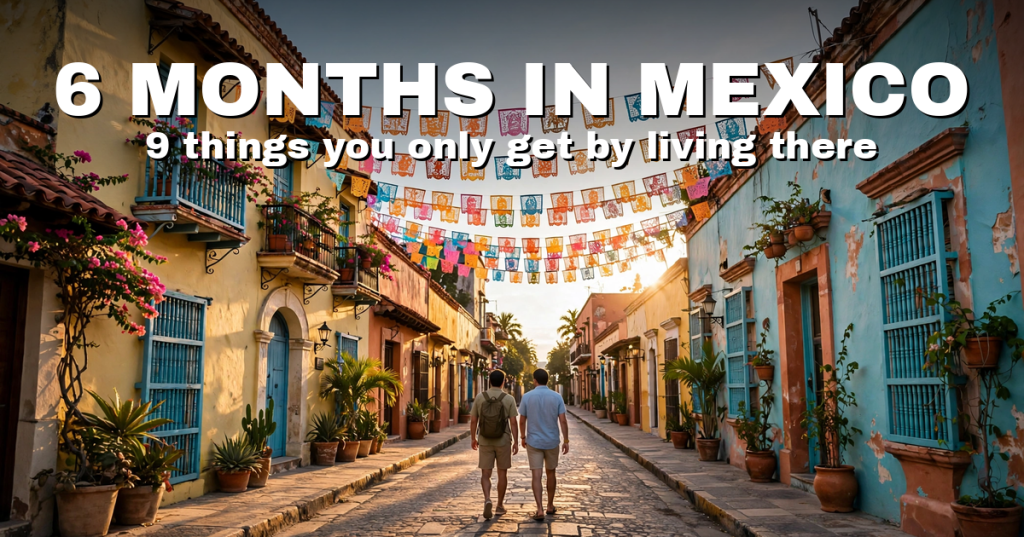
🌐 This article is also available in French and Spanish.
After two weeks, we thought we had it figured out… but we’d only seen the surface.
We saw the beautiful spots. We ate Mexican food. We took a few photos. We might even have started saying “hola” with way too much confidence. It’s happened to us. 😅
And when you stay for six months, the scenery stops being just a postcard.
We don’t exactly travel the same way anymore. We’re no longer just looking for places to visit. We start looking for a pleasant street. Shops within walking distance. A neighborhood where we feel like going out. Places to run errands. Spots to just walk around. People who speak neither English nor French!
We live in Mexico for about six months a year, and we’ve lived in Puerto Vallarta, Mérida, Bacalar, Cancún, Holbox, Campeche, Isla Mujeres, and Valladolid. Our videos mostly show that kind of life: lots of walking, neighborhoods, markets, streets, and everyday moments.
Here are nine things you understand much better when Mexico is no longer just a vacation destination.

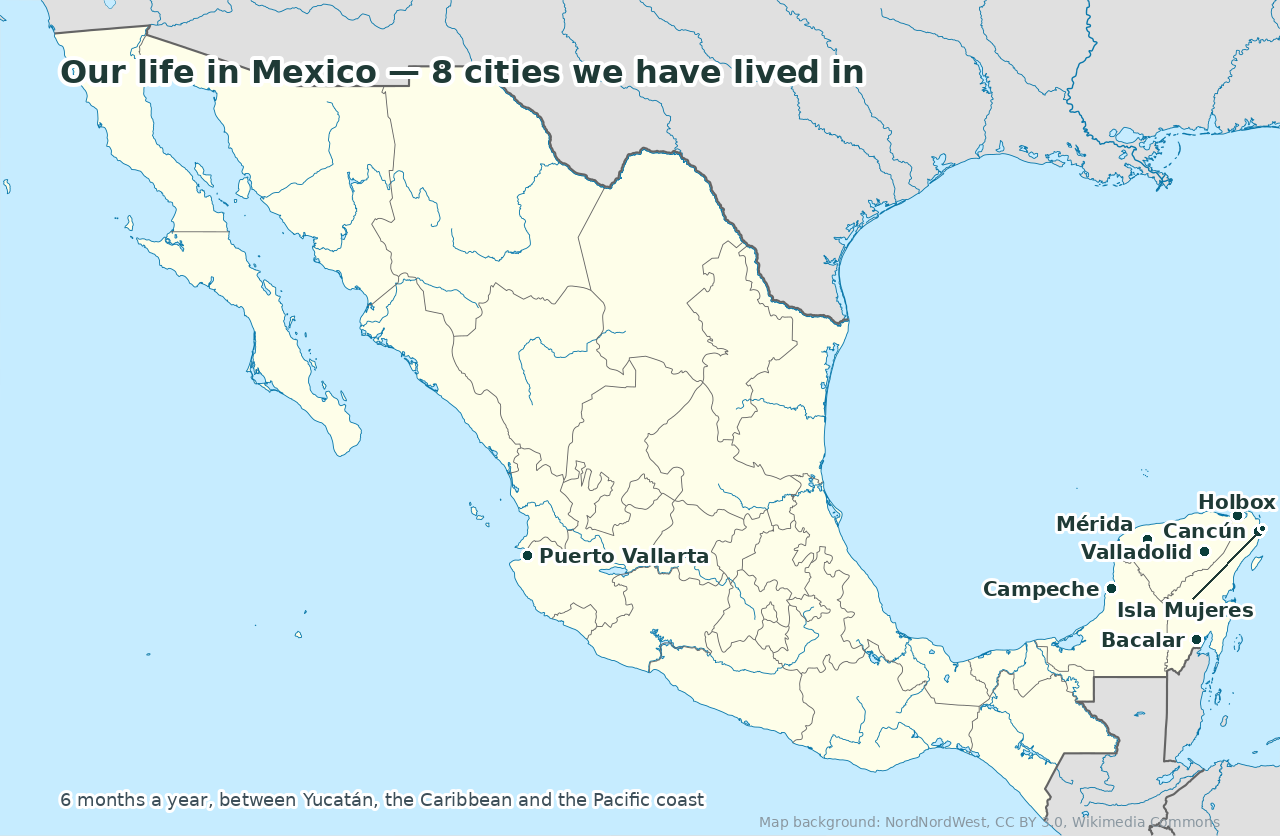
Background image: NordNordWest, CC BY 3.0, Wikimedia Commons
2 weeks
- see
- do
- Make the most of
6 months
- live
- walk
- get into a routine
1. 🏠 After six months, you’re no longer optimizing your visits. You’re optimizing your life.
When traveling for two weeks, every day counts.
You figure out what you absolutely must see. You plan your itinerary. You try to make the most of the time you have.
That’s normal.
But after several months, that mindset eventually fades away.
We’re no longer on the hunt for the next spectacular spot. We just want to find out where to buy what we need. Which street is nice to walk down. Which neighborhood makes us want to go out for no particular reason. Where we can simply take our time.
That’s one of the first things that struck us.
Our videos don’t just show attractions. They also show walks, neighborhoods, markets, Christmas moments, and an ordinary day in Mérida.
Our video “An Ordinary January… in Mérida?!” sums up this shift well.
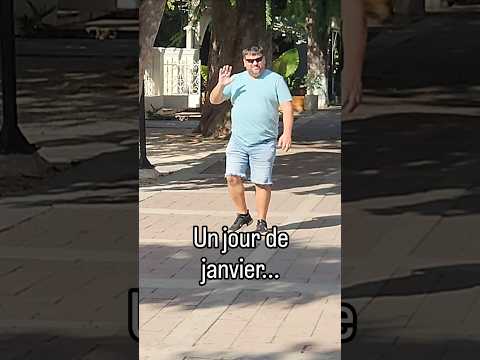
The key word here is “ordinary.”
Because when you live somewhere for months on end, the ordinary is exactly what you want to discover.
Yes, grocery shopping becomes an outing. Early retirement is less glamorous than you might think.
— Steve: “Want to go out?”
— Luc: “Where to?”
— Steve: “To the grocery store.”
We’re no longer trying to fill our days.
We’re starting to love the fact that they aren’t packed.
“After six months, we’re no longer optimizing our outings. We’re optimizing life.”
2. ⏳ Time doesn’t feel the same when you’re no longer in a hurry
Visiting a country is like running. Having time is like breathing. When you know you’ll be leaving soon, you want to move forward, see things, do things, and make the most of it. When you stay for several months, that sense of urgency disappears: you walk without having to get anywhere, you stop, you come back, you stop trying to control every minute.
And for two people who film their lives, that’s almost a revolution: a day can be wonderful even if it yields absolutely nothing to post.
Mind you, that doesn’t mean everything moves slowly in Mexico—that would be a caricature. It’s just our observation. Travel asks, “What are we doing today?” Life asks, “What do we feel like doing today?” It’s not the same vibe.
3. 🛒 Grocery shopping becomes part of the day
When you’re traveling, grocery shopping can seem like an afterthought.
When you live somewhere, it becomes part of life.
And in Mexico, our daily routine often took us to markets, tiendas, and neighborhood stores.
We’ve also gotten pretty good at the game “What is that vegetable?” We buy it, cook it, and sometimes realize afterward that maybe we should have asked. 🤷

That’s also where our style of travel comes into play.
We walk a lot.
Our walking tours aren’t just a signature feature of our videos. They’re truly a way for us to discover the places where we live.
By walking, we see so much more than just the major attractions.
We see the neighborhood shops. The streets we probably wouldn’t notice from a car. The little daily routines. The places where people actually live.
And incidentally, after 45 minutes, we finally find out if Steve was right when he said, “It’s just a little detour.”
And most importantly, you start planning your day differently.
You no longer just ask yourself, “What do we want to visit?”
You ask yourself, “What can we do on foot?”
It sounds trivial, but it completely changes the way you experience a neighborhood.
4. 🔊 Noise is no longer a minor detail when you stay for several months
On vacation, an unusual noise might just be a funny story.
When you stay for several months, it becomes part of your daily life.
Roosters. Music. Neighborhood parties. The sounds of the street.
Mexico isn’t a country that whispers.
Our alarm clock in Puerto Vallarta had feathers and no concept of punctuality.
🐓 The moment when… you stop hearing the rooster.
The first few weeks, it wakes us up. After a few months, it becomes part of the background—and maybe that’s the true measure of time passing: when the noise stops being noise.
But after several months, we also stop constantly comparing every sound to what we’re used to in Quebec.
The noise becomes part of the scenery.
That doesn’t mean we love everything, all the time. There’s a difference between accepting that a place lives at its own pace and pretending that everything is perfect.
That’s precisely the appeal of living there longer.
You discover the pleasant aspects and the little annoyances.
A two-week stay makes it easy to file those annoyances under “the Mexican experience.”
Six months, on the other hand, force you to ask yourself:
“Can I live with this?”
And that question is much more useful when you’re actually considering spending part of the year in another country.
5. 🏛️ A neighbor can become more than just a neighbor
In Mérida, we made a video called “A Classy Neighbor.”
The neighbor in question wasn’t a person.
It was a building.

On Paseo de Montejo, grand houses from a bygone era line the street with a touch of defiant elegance. When you’re just passing by, you take pictures of them. When you stay, they become landmarks.
You eventually come to recognize them. To have your favorites. To mentally greet them as you walk by—the one with the big balconies, the one with the yellow facade, the one that looks like it’s straight out of a movie.
It’s subtle, but it changes everything.
A place becomes familiar not because you’ve checked off its attractions, but because you recognize things there: streets, facades, details.
Even stones can become neighbors. As you keep running into them, you end up developing a little social life with the architecture.
“Even the stones can become neighbors.”
6. ☀️ Warm weather, lasting several months, isn’t just “nice weather”
In brochures, the heat is a bonus. Once you’re there, it’s a given.
And we’re certainly not going to complain about escaping the Quebec winter.
We even made a video about the contrast between a storm in Quebec and a day in Mérida.
Let’s just say there’s something rather cruel about watching a Quebec snowstorm on your phone while you’re enjoying the pool and the thermometer reads 36 degrees. To each their own misfortunes 😉

But living for several months in a hot climate is quite different from spending a few days in the sun.
The heat becomes a fact of daily life.
It affects when you go out. The way you walk. The rhythm of your day. Whether you want to stay outside or seek some relief from the heat.
It’s a bit like winter in Quebec, after all.
A tourist might find the snow beautiful.
A Quebecer shoveling snow in February sees it differently.
In Quebec, we shovel snow in the winter. In Mérida, we don’t shovel anything. And after a while, we almost don’t know what to do with our arms anymore.
So after several months in Mexico, you start to see the heat in a different light.
It’s no longer just a pleasant feature of the destination.
It’s a way of life, period.
And of course, we don’t always agree on the ideal temperature. Like all couples. Except that our debate sometimes takes place in French, sometimes in Spanish, and rarely leads to a definitive conclusion.
And for someone planning to spend six months a year in a hot country, this distinction is far from trivial.
7. 🏡 An apartment in a neighborhood can be more interesting than a resort
A resort is designed so you lack for nothing… and see nothing.
That’s precisely the point.
But when you’re staying for several months, the way you choose a place to stay changes.
We stay in an Airbnb by the month rather than at a hotel.
And what makes it interesting isn’t just the apartment itself.
It’s what’s around it.
A pleasant street. Shops within walking distance. A neighborhood where you feel like going out. Places to run errands. Places to just take a walk.
In other words, the place stops being just a room.
It becomes a base.
It’s less “all-you-can-eat buffet” and more “where’s the local market?” And after a few months, that suits us just fine.
It’s a big difference when you go from a few days to several months.
In Cancún, for example, our videos weren’t filmed at the resorts. Instead, we explored Cancún outside the resorts, walked through areas less associated with the destination’s classic image, and showed other facets of the city.

That’s what we’re looking for now.
Not necessarily the most spectacular.
The most livable, not the most Instagrammable.
8. 🚶 Perceived safety and actual safety aren’t always the same thing
This is probably one of the hardest topics to address honestly.
Before heading somewhere, we read a lot about safety.
We hear stories. We see headlines. We get advice.
All of that is useful.
But once we’re there, we also discover another reality: that of our daily life.
For us, walking is a big part of that experience.
In Mérida, we discovered everything by walking. Literally. Our content showcases this street life rather than an experience confined to a hotel.
Of course, that doesn’t mean we can conclude that all of Mexico is safe or that there’s nothing to fear.
That would be nonsense.
Mexico is vast, and conditions vary greatly from one place to another.
Our experience is our own.
But it taught us something important: there’s a difference between the image we form of a place before we go there and how we actually experience daily life once we’re there.
In other words: Google can give you an idea of what a neighborhood is like. Your own two feet will eventually give you your own.
Both pieces of information are useful.
Just don’t confuse the two.
9. 🗺️ The moment a place starts to feel like “home”
This is probably the hardest change to explain.
There comes a time when you stop exploring a place.
You simply start living there.
You know your way around. You have your routines. You know where to go. You recognize certain streets. You have your little landmarks.
The day you stop pulling out a map is the day you start living in the neighborhood.
And one day, you stop saying, “Let’s go back to the Airbnb or the hotel.” You just say, “Let’s go home,” or “Let’s go back to our place.”
Our videos of Mérida during the winter of 2025–2026 particularly illustrate this evolution. Christmas in Mexico. Ordinary days. Walks. Neighborhoods. Moments that aren’t necessarily “must-sees.”

Maybe that’s what the difference between traveling and living somewhere else really comes down to.
At first, you collect places to visit. After a while, you collect habits.
“At first, you collect places to visit. After a while, you collect habits.”
And it’s often these habits that make us feel at home.
Not because we’ve stopped being Quebecers.
Not because Mexico has become our country.
Simply because, for a while, our life was there.
Conclusion: Six months change everything 💛
After spending three six-month stints in Mexico, we certainly don’t claim to have understood the country.
We’ve simply come to understand a little better what it means to live there for several months.
The difference from a two-week trip isn’t just a matter of duration.
It’s a different way of life.
You discover daily life, the annoyances, the routines, the people, the heat, the noise, and the little details you don’t notice when you’re always rushing off to the next activity.
The real turning point: we’re no longer trying to discover Mexico. We’re figuring out if we could live there.
And that might be the most dangerous part: after a while, you start looking at the calendar, wondering not when you’ll leave… but when you’ll come back.

What about you? If you’ve spent several months in Mexico—or elsewhere—what did you discover only after you stopped being a tourist?


Laisser un commentaire